
A large share of failed international calls come from one mistake: the number was written in the wrong format. Getting the format right takes seconds and saves minutes you might otherwise waste. This guide shows the standard pattern and a few worked examples.
The standard international format
International numbers follow a format known as E.164. It has three parts:
- A plus sign (+), or the international access prefix used by your provider.
- The country code of the country you are calling.
- The national number, normally without the leading zero used for domestic calls.
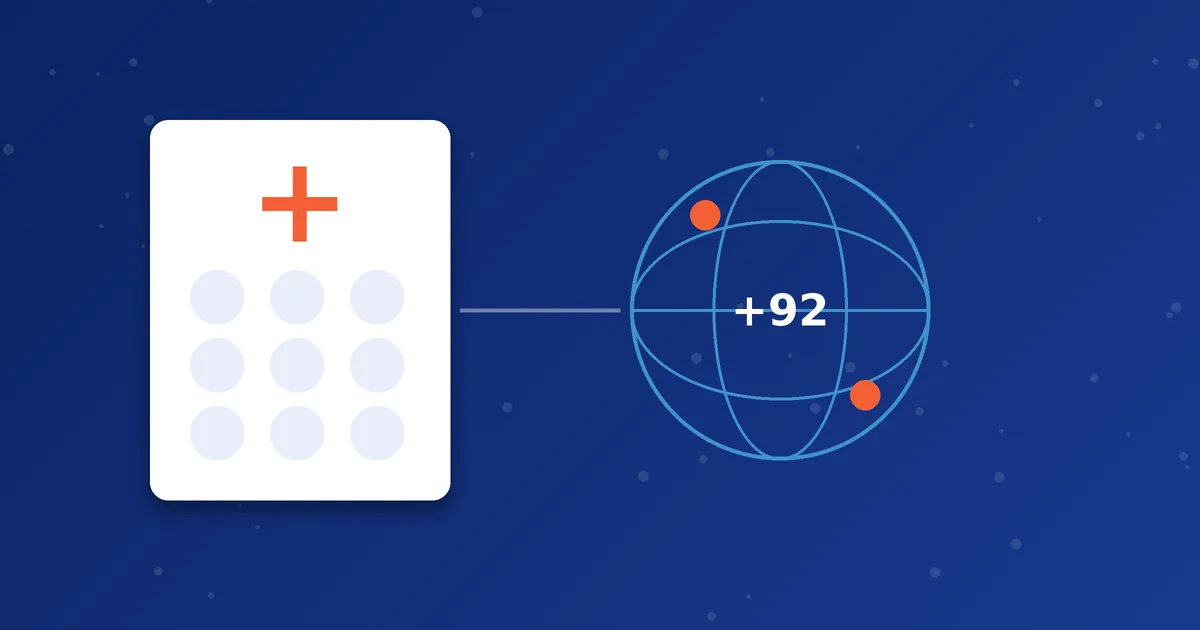
For example, a number written locally as 0300 1234567 in Pakistan becomes +92 300 1234567 for an international call. The leading zero is dropped.
Plus sign or 00?
The plus sign is the modern, universal way to write the international prefix. Many dialers accept it directly. Others need the digits your provider specifies, often 00. If a call fails with a plus sign, try the prefix your provider recommends, and if you are unsure, ask support before experimenting.
Examples
| Country | Country code | Local example | International format |
|---|---|---|---|
| Pakistan | 92 | 0300 1234567 (mobile) | +92 300 1234567 |
| United Kingdom | 44 | 07911 123456 (mobile) | +44 7911 123456 |
| United States and Canada | 1 | (415) 555-0123 | +1 415 555 0123 |
| India | 91 | 98765 43210 (mobile) | +91 98765 43210 |
| United Arab Emirates | 971 | 050 123 4567 (mobile) | +971 50 123 4567 |
These examples show format only. They are not a statement that every destination or number type is available on your package, so confirm before you order.
Common mistakes
- Keeping the leading zero. +92 0300 is wrong; use +92 300.
- Typing the country code twice. If your contact already has +92, do not add it again.
- Adding spaces or symbols the app does not accept. If a call fails, try the number as plain digits.
- Calling a landline with a mobile format. Area codes and mobile prefixes differ. Check the number type.
- Saving numbers without the country code. A contact saved with the local format works only from inside that country.
Save contacts in international format
If you often call abroad, store each contact with the plus sign and country code. That way, the same contact works wherever you are and in any dialer.
If the call still fails
Check the number again, then try a second number in the same country. If both fail, look at the error message. A 404 can mean the number is not valid for the route, as explained in our SIP error code guide. You can also read why a call may fail for the wider checklist. Check your destination before buying minutes; see how to choose a package.
Landlines, area codes and special cases
Landlines follow the same rule as mobiles: drop the leading zero and add the country code. For instance, a Karachi landline written 021 1234567 locally becomes +92 21 1234567. A Lahore number beginning 042 becomes +92 42, and an Islamabad number beginning 051 becomes +92 51. A London number written 020 7946 0000 becomes +44 20 7946 0000, and a Delhi number written 011 2345 6789 becomes +91 11 2345 6789.
Some numbers need extra care:
- Toll-free and premium numbers. Numbers beginning with codes such as 800 or 900 in some countries may not be reachable from abroad, or may be billed differently. Check before you rely on them.
- Short codes. Emergency numbers and company short codes such as three or four digit numbers are local to one country and generally cannot be dialled internationally.
- Extensions. If a number has an extension, call the main number first and enter the extension when prompted. Some dialers let you insert a pause with a comma.
- Numbers that already start with the country code. If a number is written as 0092 300 1234567, the 00 is the exit code and 92 is the country code. Write it as +92 300 1234567 instead.
A simple three-step method
- Find the local number exactly as people in that country write it.
- Remove the leading zero, if there is one.
- Add + and the country code at the front.
The United States and Canada are slightly different because they share the country code 1 and use ten-digit numbers with an area code. There is no leading zero to remove, so just add +1 in front of the ten digits.
Contacts that work from anywhere
If you save contacts in international format, they keep working when you travel or change provider. When you share a number with someone abroad, write it with the plus sign and country code as well. It avoids confusion and is a courtesy to the person who will dial it.
If you still struggle with a number, try copying it into a plain text note and checking each part: the plus sign, the country code and the rest of the digits. It is also worth asking the person you are calling to read their number to you from their own phone, because numbers copied from old messages are sometimes out of date.
Next step: Want to know whether your destination is supported? Send us the country and number type on WhatsApp before you order.
Frequently asked questions
Do I include the country code when calling inside my own country?
Normally no. Use the local format unless your dialer or provider says otherwise.
What if the dialer adds a prefix automatically?
Some dialers add a prefix based on settings. If a call fails, check the dialer settings and ask support.
Where can I find a country code?
The national telecom authority or a reliable international dialling code list will show it. The examples above cover common destinations.